SDR-Shark
Spectrum collection, IQ replay, FFT, waterfall, scanner workflows, signal activity, and RF/ML hooks.
Platform Overview
RTG Spectrum turns RF and wireless observations into a source-aware event plane: collect, normalize, correlate, establish baseline, detect change or anomaly, and support operator decisions.
60-second architecture
Each module keeps its purpose and evidence type, but the output is made reviewable in a common timeline. That is the difference between a set of demos and a platform.
Spectrum collection, IQ replay, FFT, waterfall, scanner workflows, signal activity, and RF/ML hooks.
Multi-protocol RF detections, entity tracking, WiFi topology, strong Bluetooth Classic, BLE, Zigbee, and WiFi workflows, plus experimental FM and sub-GHz paths.
HaLow and WiFi observations, AP/station topology, survey state, Pattern-of-Life indicators, and report exports.
Fast cellular state snapshots, broad LTE/5G inventory, high-rate live signal measurements, coverage-map context, and shared event outputs.
Defense prototype cues, passive DJI/OcuSync-family RF evidence, acoustic corroboration, station state, and operator map context.
Unified timeline and Pattern-of-Life layer for BLE, GPS, WiFi, RF, spectrum, cellular survey, and mission events.
What moves between modules
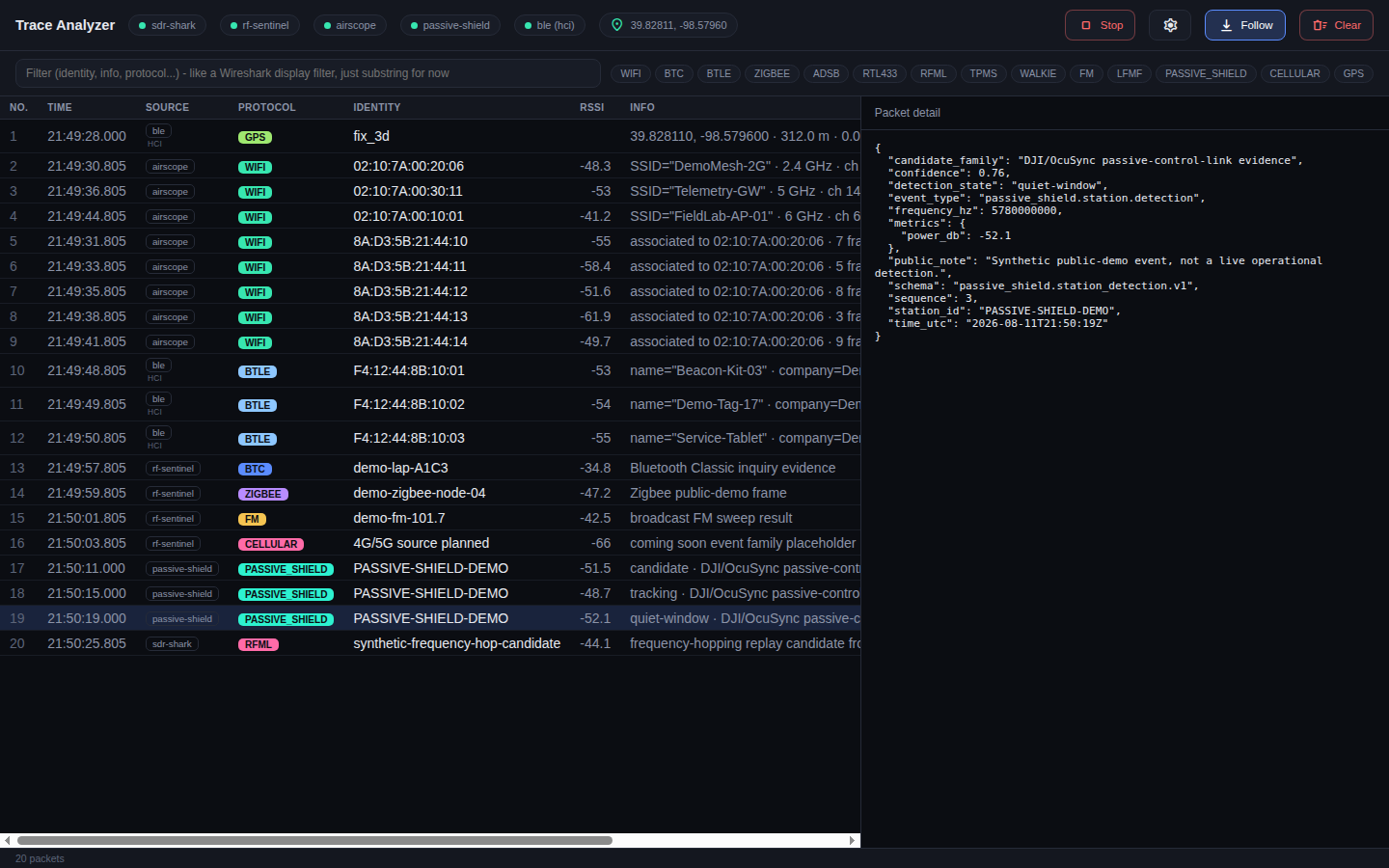
The important boundary is the event model: source, timestamp, protocol, identity, signal, location or context where available, and raw detail for review. This lets a reviewer compare a WiFi AP, BLE observation, cellular survey record, spectrum event, passive drone-signal cue, and operator status without flattening away where the evidence came from.
Buyer outcomes
Put detections, entities, health, topology, and raw detail into interfaces a reviewer can inspect quickly.
Track recurring infrastructure, normal timing, known devices, channel use, and survey-to-survey behavior.
Surface new, missing, recurring, anomalous, or mission-relevant activity with source context attached.
Review WiFi, BLE, cellular, RF, GPS, spectrum, and prototype mission cues together instead of in isolated dashboards.
Use route-tagged measurements, coverage context, and uncertainty-aware source estimates to guide follow-on collection.
Create screenshots, exports, reports, and claim-boundary notes that support engineering, prototype, or partner reviews.
Use Dockerized demos, replay data, health/status views, and repeatable workflows to move prototypes toward field testing.
Commercial Paths
Baseline a site or RF environment and produce reviewable evidence around recurring entities, topology, and changes.
Integrate customer hardware or data sources into normalized events, Trace Analyzer, dashboards, and reports.
Build a bounded SDR or RF sensing prototype with replay data, operator UI, and technical findings.
Deployment maturity evidence
SDR-Shark and RF Sentinel have public Docker demo workflows with deterministic replay or event generation.
Synthetic IQ and event feeds let reviewers see behavior without real RF captures, local networks, or sensitive locations.
Trace Analyzer screenshots are generated from mock event payloads through the same normalizers used by the app.
The Cellular Survey module combines complementary measurement paths with public-safe screenshots for LTE/5G inventory, serving-neighbor topology, live signal trends, PCAP recording, and coverage-map workflows.
AirScope shows Markdown, HTML, PDF, CSV, JSON, and JSONL style evidence workflows for wireless survey review.
Public-safe R&D roadmap
Current internal R&D is aimed at defense-relevant demonstrations that build on this shared event plane: parallel sensor fusion, mission debrief and replanning, modular reference-bus integration, counter-swarm analytics, geospatial RF evidence, and operator decision support. Public versions should stay synthetic or sanitized, show measured behavior, and keep claim boundaries visible.
Known truth, route-tagged observations, estimated source area, uncertainty, and a recommended second collection route.
Replay a completed mission, reconstruct the timeline, fuse status sources, extract findings, and recommend follow-on collection.
Show a new module joining the event plane without rewriting existing collectors or dashboards.
Use PASSIVE-SHIELD replay evidence to show staged activation, spatial residuals, and conservative hypothesis boundaries.