Back to Case Studies

Case Study

Does fusing raw sensor data into one operator view actually help?

A public-safe demo measuring decision speed and accuracy when an operator sees a fused, single-pane status view versus the same underlying raw, fragmented per-source data.

Problem

Fragmented interfaces are assumed to slow decisions. The useful question is whether that can be measured.

Operators juggling multiple independent status sources, each reporting its own confidence, availability, and health, are commonly assumed to make slower or less reliable decisions than an operator looking at one fused view. RTG built a live scenario harness and a controlled A/B-style test to measure that difference rather than simply assert it.

Scenario Inputs

  • Four independent, schema-versioned status sources feeding one real-time scenario
  • A rule-based fusion layer combining them into one confidence level and recommended posture
  • A representative multi-zone degrade/recover pattern, not a single clean transition
  • The same underlying ground truth shown two ways: fused versus raw per-source
Result

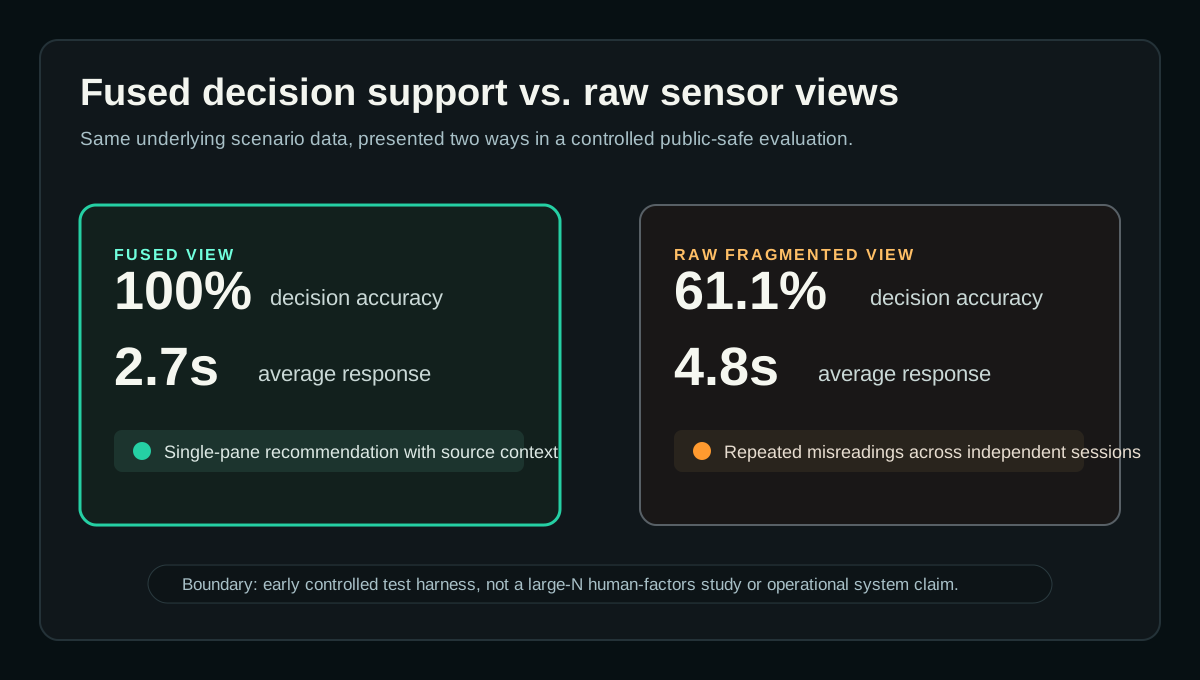
The fused view was both faster and more accurate in the controlled test sessions.

Fused view

100% decision accuracy and 2.7 seconds average response time across the tested scenario range.

Raw fragmented view

61.1% decision accuracy and 4.8 seconds average response time, or roughly 75% slower for a worse outcome.

Repeatable failure modes

The raw-data errors were not random. The same misreadings recurred across independent test sessions.

Technical approach

Independent sources, one late-bound fusion consumer, explicit logic.

Each status source publishes independently to a shared schema-versioned bus, with no source aware of any other. A decision-support consumer subscribes to the sources and produces an explicit rule-based recommendation that an operator or reviewer can audit. The same architecture pattern underlies RTG Spectrum's broader event-plane approach: source-aware events, normalized review, and operator-facing decision support.

What this proves

  • Fusing fragmented status data measurably improved decision speed and accuracy in this test
  • Raw, unfused data produced specific repeatable misreadings, not just slower decisions
  • A new status source can be added without modifying the existing sources
  • The fusion logic's recommendations are explicit and auditable, not opaque model outputs

What is intentionally not claimed

  • Not a claim about any specific sensor, GPS, or navigation product
  • Not a large-N human-factors study or a demographically representative participant pool
  • Not a live operational system claim
  • Not a claim that fusion eliminates operator error, only that it reduced it in this test

Why it matters

  • Turns "fusion helps operators" from an assumed benefit into a measured workflow
  • Shows the schema-versioned event-bus pattern applies directly to operator decision support
  • Gives buyers a concrete evaluation method: measure decision speed and accuracy
  • Creates a repeatable harness that can be re-run with more participants or new scenarios